
I launched a clean, minimalist web utility that loaded in 200ms. Three weeks later, Google Search Console impressions were a flat line at zero.
Crawlers didn't care about my React code. They needed text. They needed meta descriptions, Open Graph tags, sitemaps, JSON-LD schemas, and robots.txt files. Writing all of that by hand for every project was the most mechanical, joyless work in software development.
Then I realized: this is exactly what LLMs are built for.
Large language models are exceptional syntax compilers. They understand structure, constraints, and standards. Instead of writing SEO boilerplate manually, I could encode the entire ruleset into a single declarative prompt and get a production-ready SEO package in seconds.
This post walks through that prompt, why it works, and how to use it.
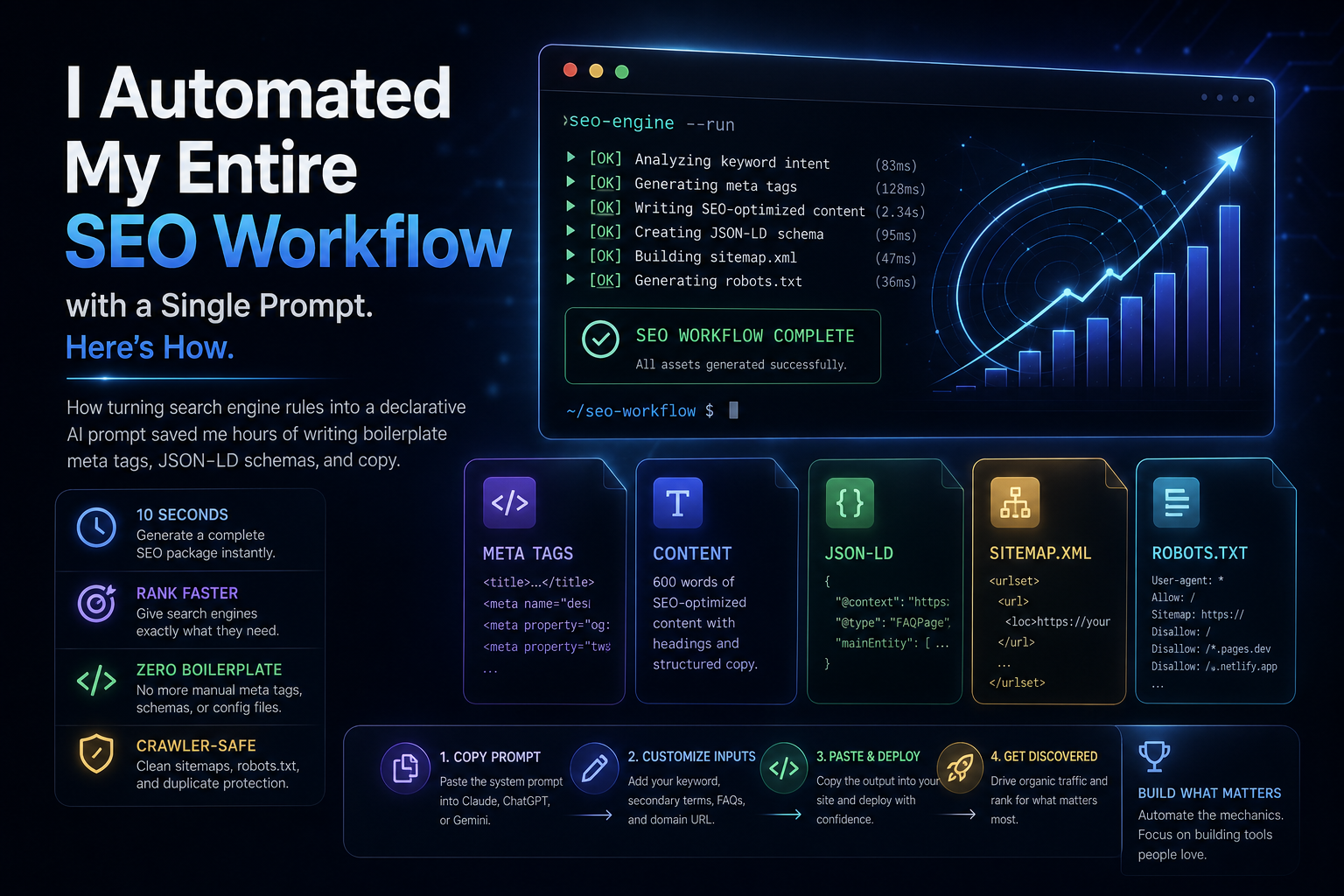
What This Workflow Generates
| Asset | Purpose |
|---|---|
| ✅ SEO Title | Under 60 chars, keyword-first |
| ✅ Meta Description | 140–155 chars with soft CTA |
| ✅ Open Graph Tags | Social sharing previews |
| ✅ Twitter Cards | summary_large_image format |
| ✅ Canonical URL | Prevents duplicate indexing |
| ✅ JSON-LD Schemas | WebSite, Organization, SoftwareApplication |
| ✅ FAQ Schema | FAQPage structured data for rich results |
| ✅ Homepage Copy | 600 words, naturally optimized |
| ✅ sitemap.xml | Canonical URL map for crawlers |
| ✅ robots.txt | Crawler rules + sitemap pointer |
| ✅ Internal Linking | Anchor text and page suggestions |
| ✅ Social Copy | Twitter, LinkedIn, Product Hunt posts |
| ✅ Dev Checklist | Deployment-ready verification list |
How the Workflow Fits Together
Keyword Input
     ↓
AI Prompt Engine
     ↓
┌──────────────────────────────────┐
│  Metadata  │  JSON-LD  │  Copy   │
│  sitemap   │  robots   │  FAQs   │
└──────────────────────────────────┘
     ↓
Paste into codebase
     ↓
Deploy
     ↓
Google crawls
     ↓
Rank
The entire pipeline — from keyword to deployed SEO package — takes under five minutes.
🚀 The Complete SEO Engine Prompt
Copy the prompt below and paste it directly into Claude, ChatGPT, or Gemini. Fill in the bracketed fields and run it once.
You are an expert Technical SEO Engineer, Search Strategist,
UX Copywriter, and Senior Software Documentation Writer.

Your goal is to produce a COMPLETE, production-ready SEO
package for a modern web application.

INPUT
─────────────────────────────────────────
Main Keyword:      [ ]
Secondary Keywords: [ ]
Domain:            [ ]
Brand Name:        [ ]
Tool Description:  [ ]
Target Audience:   [ ]
FAQ Questions:     [ ]
─────────────────────────────────────────

OUTPUT — generate ALL of the following sections.
Wrap each section in a clearly labelled fenced code block.
Do not use placeholder text. Fill every field completely.

────────────────────────────────────────────────────────
1. SEO METADATA
────────────────────────────────────────────────────────
• Title tag — keyword-first, under 60 characters
• Meta description — 140–155 chars, main + secondary
  keyword, ends with a soft call to action
• Canonical link tag
• Robots meta tag
• Complete Open Graph tags (og:title, og:description,
  og:image, og:url, og:type, og:site_name)
• Complete Twitter Card tags (summary_large_image)

────────────────────────────────────────────────────────
2. HOMEPAGE COPY  (exactly 600 words)
────────────────────────────────────────────────────────
Requirements:
• Hook in the opening paragraph (curiosity or pain point)
• Main keyword in the first 100 words
• All secondary keywords used naturally — no stuffing
• Proper H2/H3 heading hierarchy
• One internal link placeholder + one external authority
  link placeholder
• Closing paragraph with implicit CTA
• Human-sounding, helpful tone

────────────────────────────────────────────────────────
3. STRUCTURED DATA  (valid JSON-LD)
────────────────────────────────────────────────────────
Generate separate <script type="application/ld+json"> blocks for:
• WebSite schema
• Organization schema
• SoftwareApplication schema
• BreadcrumbList schema
• FAQPage schema (using the FAQ questions provided)

────────────────────────────────────────────────────────
4. INTERNAL LINKING SUGGESTIONS
────────────────────────────────────────────────────────
Suggest:
• 10 internal anchor text phrases
• 10 supporting page ideas (slug + title)
• 5 blog post ideas with H1 titles

────────────────────────────────────────────────────────
5. TECHNICAL SEO FILES
────────────────────────────────────────────────────────
Generate:
• sitemap.xml — homepage + primary pages, today's date
• robots.txt — allow all major crawlers, block /admin
  /api /_next /staging, include Sitemap directive
• Recommended canonical strategy (1 paragraph)
• Suggested X-Robots-Tag header rules for preview envs
• Recommended cache-control headers for static assets

────────────────────────────────────────────────────────
6. PERFORMANCE SUGGESTIONS
────────────────────────────────────────────────────────
List specific, actionable improvements for:
• LCP (Largest Contentful Paint)
• CLS (Cumulative Layout Shift)
• INP (Interaction to Next Paint)
• Accessibility (WCAG 2.1 AA)
• Mobile SEO

────────────────────────────────────────────────────────
7. RICH SNIPPET OPPORTUNITIES
────────────────────────────────────────────────────────
Identify opportunities for:
• Featured Snippets (format + target query)
• People Also Ask coverage
• FAQ rich results
• Video result opportunities

────────────────────────────────────────────────────────
8. SOCIAL PREVIEW COPY
────────────────────────────────────────────────────────
Write ready-to-post copy for:
• Twitter/X post (under 280 chars)
• LinkedIn post (150–200 words, professional tone)
• Product Hunt tagline + description

────────────────────────────────────────────────────────
9. DEPLOYMENT CHECKLIST
────────────────────────────────────────────────────────
Return a checkbox list covering every SEO task that must
be verified before going live.

────────────────────────────────────────────────────────
10. DEVELOPER BLOG ARTICLE
────────────────────────────────────────────────────────
Write a polished, publication-ready technical blog post
(800–1000 words) in Markdown that:
• Explains the SEO strategy behind this tool
• Describes why each generated asset exists
• Shows developers how to implement and adapt the output
• Covers 3 common SEO mistakes developers make
• Ends with actionable deployment tips

Tone: experienced software engineer writing for peers.
Target: Dev.to, Medium, Hashnode, or a personal blog.
Why This Works
Most SEO tools are output tools — they check what you already have and score it. This prompt is an input tool — it generates what you need from scratch, calibrated to your specific context.
The key insight is that search engine rules are well-specified and stable. Google's guidelines for title tags haven't changed in years. Schema.org vocabulary is versioned. robots.txt syntax is a published standard. These are exactly the kinds of constraints that LLMs handle well.
By encoding those constraints as a prompt, you turn SEO from a creative task into a compilation task. And compilers are fast.
Real Output Example
Here's a slice of what the prompt generates for a hypothetical AI image compressor tool:
Meta tags:
<title>AI Image Compressor | Free Online Tool</title>
<meta name="description" content="Compress images online without losing quality. Free AI-powered tool — no upload limits, no sign-up." />
<link rel="canonical" href="https://example.com/" />
JSON-LD:
{
  "@context": "https://schema.org",
  "@type": "SoftwareApplication",
  "name": "AI Image Compressor",
  "applicationCategory": "UtilitiesApplication",
  "operatingSystem": "Web",
  "offers": {
    "@type": "Offer",
    "price": "0",
    "priceCurrency": "USD"
  }
}
robots.txt:
User-agent: *
Allow: /
Disallow: /admin
Disallow: /api
Disallow: /_next
Sitemap: https://example.com/sitemap.xml
Paste. Done. Google-ready in under two minutes.
The Three Mistakes This Prompt Prevents
1. Duplicate indexing of staging environments.
Developers forget that pages.dev, netlify.app, and vercel.app preview URLs get indexed by Google. The prompt generates explicit X-Robots-Tag: noindex header rules and canonical tags that point only to production.
2. Missing FAQPage schema.
FAQ schema is one of the easiest rich results to earn and one of the most consistently skipped. The prompt generates the full application/ld+json block automatically.
3. Keyword stuffing in meta descriptions. Meta descriptions don't directly affect rankings — they affect click-through rate. The prompt is explicitly instructed to write copy that reads naturally to humans, not to optimize for a keyword density metric that doesn't exist.
Conclusion
Modern SEO is less about gaming search engines and more about communicating clearly with them. Large language models excel at generating structured, standards-compliant content — making them an ideal tool for repetitive SEO work.
By turning SEO requirements into a declarative prompt, I replaced hours of manual boilerplate with a workflow that takes minutes. The final section of the prompt — write the blog post — means the workflow is self-documenting. Run it once and you have not just the metadata, but the article explaining the metadata.
That leaves more time for the only part of building that actually matters: making something worth finding in the first place.